


Master of Occupational Therapy
An ACOTE-accredited master's that prepares you to become a licensed occupational therapist — delivered in a hybrid format so you can study online and come to campus for hands-on intensives.
Program Overview
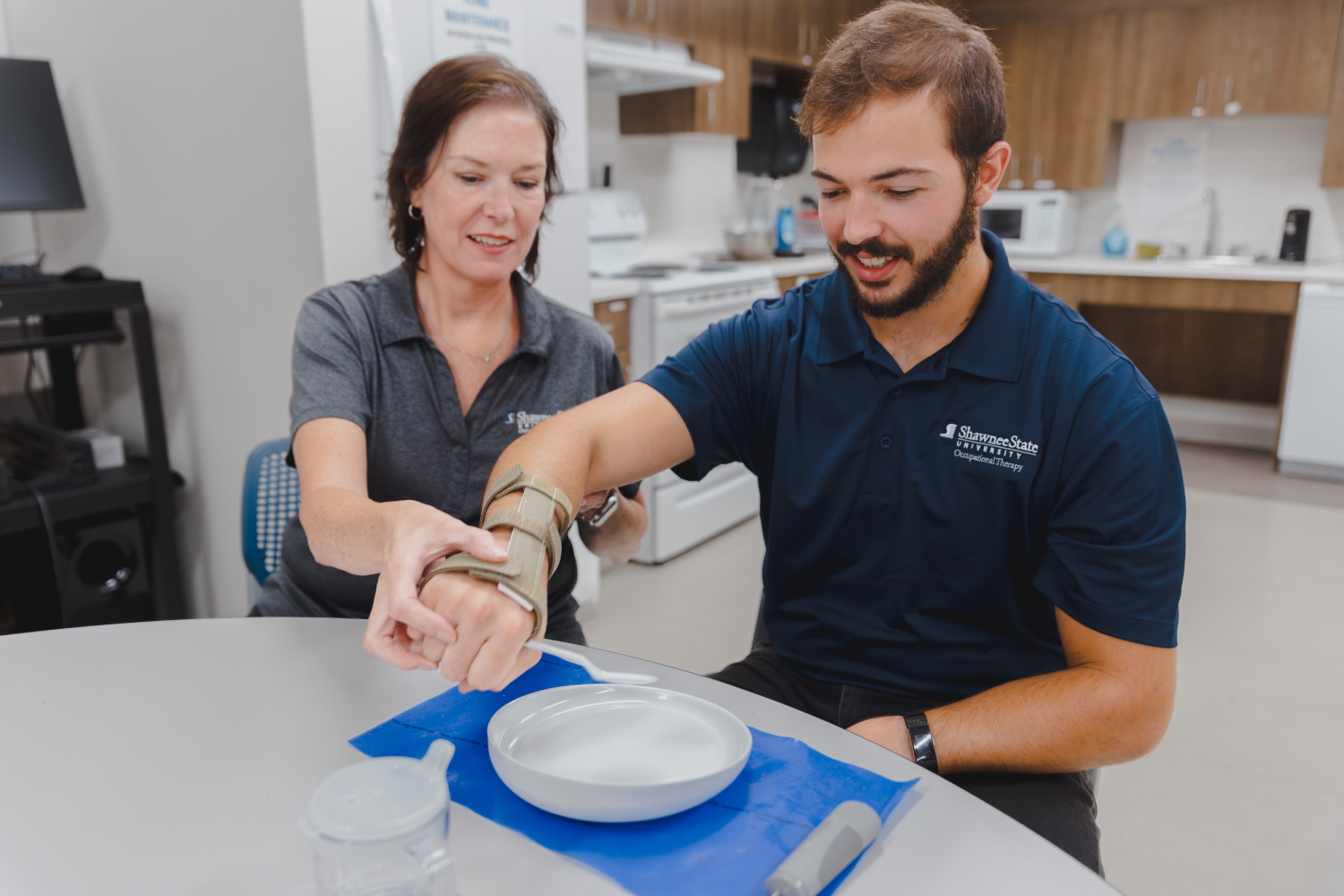
Shawnee State University’s Master of Occupational Therapy (MOT) program prepares students to lead in a growing and essential field of healthcare. Through a rigorous and supportive curriculum that blends in-person and remote learning, you’ll gain the expertise to help individuals of all ages regain or develop skills for everyday living and independence.
Approved for a hybrid learning format beginning in 2024, the occupational therapy master's offers flexibility without sacrificing hands-on experience. Students complete online occupational therapy coursework — a mix of synchronous and asynchronous sessions — while attending three immersive in-person weeks on campus each semester prior to Level II fieldwork. This approach allows you to balance your education with work or personal commitments while building practical skills in preparation for clinical rotations.
With small cohorts, accessible faculty, and deep ties to clinical partners across the region, the occupational therapist degree emphasizes personalized learning and real-world readiness. You’ll be equipped to make a difference in hospitals, rehabilitation centers, schools, community health, and more.
Career Outcomes
Apply Now
Admission Requirements
Priority deadline: December 1
Final deadline: June 1
For more detail about admission requirements and application instructions, see the Admission Process Page
Graduate Admissions
Phone: (740) 351-3177
Email: gradadmissions@shawnee.edu
At A Glance
Master of Occupational Therapy
Degree
M.O.T.
Class Size
15:1
Location
Hybrid — online with on-campus intensives in Portsmouth, Ohio

Why Study Master of Occupational Therapy at Shawnee University
Hybrid format built for working adults. You complete most coursework online (a mix of synchronous and asynchronous), with three intensive in-person weeks each semester before Level II fieldwork.
Fieldwork is built into the program. Minimum of 24 weeks of full-time Level II Fieldwork, plus Level I rotations, give you the hands-on experience employers expect.
Small cohorts, accessible faculty. You learn from instructors who know your name and your goals, and from clinicians active in the field.
ACOTE-accredited, licensure-ready. Graduates are eligible to sit for the NBCOT exam and become Occupational Therapist Registered (OTR). The curriculum meets licensure requirements in all 50 states.
MOT coursework blends academic foundations with applied clinical training, sequenced across semesters and capped by full-time Level II fieldwork.
- Occupational performance across the lifespan
- Neurological and orthopedic rehabilitation
- Therapeutic intervention and assistive technology
- Mental health and psychosocial practice
- Clinical reasoning, professional ethics, and leadership
- Research methods and evidence-based practice
- Level I fieldwork rotations
- Level II clinical fieldwork: (minimum of 24 weeks full-time)
Prerequisites are required before admission and include lifespan and abnormal psychology, cultural anthropology or sociology, medical terminology, statistics, two anatomy and physiology courses, neuroscience, and kinesiology — about 29 credits total.
View the full curriculum and sample schedule in the Academic CatalogExperiential learning runs through the whole program: simulation-based labs during in-person intensive weeks, Level I rotations to introduce you to clinical settings, and full-time Level II fieldwork in real practice environments. All Level II Fieldwork has to be completed within 12 months of finishing your academic coursework.
Graduates of the MOT are prepared to:
- Evaluate and treat patients using evidence-based OT interventions
- Demonstrate professional, ethical decision-making in clinical settings
- Apply leadership skills on interprofessional healthcare teams
- Advocate for clients and advance occupational justice in diverse communities
- Sit for the NBCOT certification exam and qualify for state licensure
Hybrid format: online coursework (synchronous and asynchronous) plus three intensive in-person weeks each semester on the Portsmouth, Ohio campus, in the Department of Rehabilitation Sciences.
MOT graduates work as licensed occupational therapists in:
- Hospitals and rehabilitation centers
- Outpatient clinics and home health
- Schools and pediatric practice
- Skilled nursing and long-term care
- Community health, behavioral health, and mental health settings
Occupational therapy is in strong, sustained demand nationally. The MOT curriculum meets licensure requirements in all 50 U.S. states.
Required Completion
Free Tuition and Financial Aid
Shawnee State's tuition is among the lowest in Ohio, and the Shawnee Advantage Tuition Guarantee keeps your rate flat for four years. Scholarships including Choose Ohio First and the Pell-Eligible Free Tuition Program may also apply.
See if you Qualify for Free Tuition
Ohio students can apply to receive a $1,500 scholarship up to full-tuition when you apply and are accepted.
Learn More about Choose Ohio FirstMaster of Occupational Therapy Frequently Asked Questions
Yes. MOT students may qualify for awards ranging from $1,500 to full tuition through Choose Ohio First, plus other institutional and federal aid.
The preferred deadline is December 1. Applications are accepted on a rolling basis until the class is full — applying by the preferred date gives you the best chance for early consideration and scholarship review.
Program handbook
The current Master of Occupational Therapy Student Handbook (2026-2027) is available below:
Accreditation
The Occupational Therapy program is accredited by the Accreditation Council for Occupational Therapy Education (ACOTE) of the American Occupational Therapy Association (AOTA), located at 7501 Wisconsin Avenue, Suite 510E, Bethesda, MD 20814. ACOTE’s telephone number, c/o AOTA, is (301) 652-AOTA (2682) or (301) 652-6611, and its web address is acoteonline.org.
Graduates are able to sit for the national certification examination for the occupational therapist administered by the National Board for Certification in Occupational Therapy, Inc. (NBCOT), located at One Bank Street, Suite 300, Gaithersburg, MD 20878. Our curriculum meets the educational requirements for licensure in all 50 states. NBCOT sets its own criteria for taking the exam, which may include questions on the applicant's criminal history. A felony conviction may affect a graduate's ability to sit for the NBCOT Certification examination or attain state licensure.
For more information on these limitations, you can contact NBCOT at (301) 990-7979. After successful completion of this exam, the individual will be an Occupational Therapist, Registered (OTR). Most states require licensure in order to practice; however, state licenses are usually based on the results of the NBCOT Certification Examination.
National Board for Certification in Occupational Therapy (NBCOT®) program data results: School Performance
