Newly developed hybrid format blending in-person immersion weeks with remote online learning.
Help Improve the Lives of Others
Occupational therapy (OT) is a health profession focused on helping individuals of all ages perform everyday activities, or "occupations," that may be impacted by injury, illness, or disability. Occupational therapists work with individuals to improve their ability to engage in meaningful activities such as dressing, cooking, working, and socializing, promoting independence and improving quality of life.
Flexible Hybrid Format
Shawnee State University’s Master of Occupational Therapy program is delivered in a newly developed hybrid format that blends in-person immersion weeks with remote online learning. This approach combines flexibility with hands-on, high-impact instruction:
On-Campus Immersions: Students attend three in-person weeks each semester, focused on labs, simulations, and collaborative learning.
Online Coursework: Between immersions, classes are conducted both synchronously (live) and asynchronously (self-paced), providing structure and flexibility.
National & State Alignment: The curriculum meets licensure requirements in all 50 states and prepares graduates to sit for the National Board for Certification in Occupational Therapy (NBCOT) exam.
Ebenezer Asiaw
Assistant Director of Graduate Admissions
(740) 351-3258 easiaw@shawnee.edu
Program News
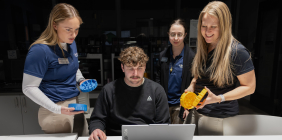
Shawnee State University Students Bridge Disciplines Through Hands-On Collaboration in 3D Printing and Occupational Therapy
Students in the Master of Occupational Therapy and the Bachelor's in Plastics Engineering Technology programs at Shawnee State University recently came together for an interdisciplinary learning experience...
This specialty 3+2 degree offers a baccalaureate in the study of health and occupation and upon successful completion in three years you will be admitted into the Master of Occupational Therapy program.
Careers in Occupational Therapy cover all areas of life. Whether you’re interested in working with children, older adults, individuals recovering from injury, or communities in need, occupational therapy offers opportunities to make a meaningful impact.
OT is a growing profession with excellent job prospects, strong salaries, and the flexibility to work in hospitals, schools, rehabilitation centers, home health, and community programs. Most importantly, it’s a career that allows you to help people live life to its fullest.
High Demand: OT jobs are projected to grow 14% by 2034, creating over 10,000 openings each year.
Strong Salaries: Median annual pay for OTs is $98,340; OTAs earn about $68,340.
Flexibility: Work in hospitals, schools, clinics, homes, and community programs.
Impact: Help people of all ages live healthier, more independent, and meaningful lives.
Shawnee State’s MOT program equips you with the knowledge, skills, and real-world experience to thrive in this rewarding profession.
What does an Occupational Therapist do?
Occupational therapy helps people of all ages do the activities that are most important to them, from daily routines and self-care to school, work, leisure, and community life. An occupational therapist begins by evaluating your unique situation and, with input from you and often your family or care providers, develops individualized goals that reflect your needs and values. Together, you and your therapist create a personalized intervention plan designed to improve or maintain your ability to participate in meaningful daily activities, ultimately helping you return to or pursue the life you want to live.
Occupational therapists also extend their impact beyond individuals to focus on groups and communities. They may develop and implement programs that promote healthy behaviors, support older adults with safe driving and aging in place, assist military service members transitioning back to civilian life, or address broader challenges such as homelessness, youth development, mental health, and addiction recovery. Through this holistic and client-centered approach, occupational therapy empowers people and communities to live life to its fullest.
At Shawnee State University, our Master of Occupational Therapy program prepares students to take on these vital roles—equipping graduates with the knowledge, skills, and hands-on experiences needed to become compassionate, evidence-based practitioners ready to make a difference in the lives of individuals, families, and communities.
BSOT to MOT (Direct-Entry Pathway to MOT)
At Shawnee State University, students admitted into the Bachelor of Science in Occupational Therapy (BSOT) program are part of a direct-entry pathway toward earning a Master of Occupational Therapy (MOT) degree.
Graduate Program Information
A graduate degree in occupational therapy prepares students with the knowledge, skills, clinical reasoning, and professional competencies necessary for entry-level occupational therapy practice. The Shawnee State University Master of Occupational Therapy (MOT) Program emphasizes occupation-centered, evidence-based practice through a combination of didactic coursework, laboratory experiences, simulation activities, service-learning opportunities, scholarly inquiry, and fieldwork education.
The curriculum is designed to prepare graduates to serve individuals, groups, populations, and communities across a variety of healthcare, educational, community, and emerging practice settings while promoting participation, health, well-being, and quality of life.
The program requires a minimum of 24 weeks of full-time Level II Fieldwork completed under the supervision of qualified occupational therapy practitioners. These experiences provide students with opportunities to apply academic knowledge and professional skills in real-world practice environments. Students are responsible for transportation, housing, and any costs associated with fieldwork placements.
Students must successfully complete all Level II Fieldwork requirements within 12 months following completion of the didactic portion of the Master of Occupational Therapy program. Timely completion of Level II Fieldwork is required to maintain progression toward graduation, satisfy program requirements, and establish eligibility for graduation and application for the National Board for Certification in Occupational Therapy (NBCOT®) certification examination.
Ebenezer Asiaw
Assistant Director of Graduate Admissions
(740) 351-3258 easiaw@shawnee.edu
Accreditation
The Occupational Therapy program is accredited by the Accreditation Council for Occupational Therapy Education (ACOTE) of the American Occupational Therapy Association (AOTA), located at 7501 Wisconsin Avenue, Suite 510E, Bethesda, MD 20814. ACOTE’s telephone number, c/o AOTA, is (301) 652-AOTA (2682) or (301) 652-6611, and its web address is acoteonline.org.
Graduates are able to sit for the national certification examination for the occupational therapist administered by the National Board for Certification in Occupational Therapy, Inc. (NBCOT), located at One Bank Street, Suite 300, Gaithersburg, MD 20878. Our curriculum meets the educational requirements for licensure in all 50 states. NBCOT sets its own criteria for taking the exam, which may include questions on the applicant's criminal history. A felony conviction may affect a graduate's ability to sit for the NBCOT Certification examination or attain state licensure.
For more information on these limitations, you can contact NBCOT at (301) 990-7979. After successful completion of this exam, the individual will be an Occupational Therapist, Registered (OTR). Most states require licensure in order to practice; however, state licenses are usually based on the results of the NBCOT Certification Examination.
National Board for Certification in Occupational Therapy (NBCOT®) program data results: School Performance