Bachelor of Science in Mathematics: Actuarial Science
If you like math and want a high-demand career, actuarial science is hard to beat. This concentration combines a rigorous math core with the probability, statistics, and interest theory aimed at the first two Society of Actuaries (SOA) exams.
Program Overview
Shawnee State University’s Bachelor of Science in Mathematical Sciences with a Concentration in Actuarial Sciences equips students with the tools to succeed in this high-demand, well-compensated profession.
This specialized four-year degree provides rigorous training in calculus, probability, statistics, and interest theory. Students also complete supporting coursework in economics and computer programming, with classes designed to prepare them for the first two actuarial certification exams.
By graduation, students will have developed advanced computational and analytical skills, the ability to solve problems independently, and the confidence to communicate technical concepts clearly—whether in the boardroom or a graduate-level seminar.
Career Outcomes
How to Apply
-
Start your application
Free, takes about 15 minutes.
-
Send transcripts
Have your high school guidance counselor send them to admissions@shawnee.edu
-
File the FAFSA
School code 009942. Required for financial aid.
-
Get your decision
Most admission decisions in under 7 days.
At A Glance
Bachelor of Science in Mathematics: Actuarial Science
Degree
B.S.
Format
On Campus
Length
4 years
Credits
120
Why Study Bachelor of Science in Mathematics: Actuarial Science at Shawnee University
Built around SOA exams. Coursework lines up with Exam P (Probability) and Exam FM (Financial Mathematics) which are the first two Society of Actuaries exams.
Probability problem-solving and interest theory seminars. Targeted exam-prep seminars give you focused practice on exam-style problems.
Economics and programming foundations. You'll round out the math with micro/macroeconomics and a programming course - both useful in actuarial roles.
A clear pathway to graduate study. Strong preparation for graduate work in actuarial science, data science, or financial mathematics.
The 120-credit concentration combines the standard Mathematical Sciences core with a 19-credit actuarial sciences option, computer science, and economics support courses.
- Mathematical Sciences Core (34 credits): Calculus I-III, Discrete Math with Graph Theory, Linear Algebra, Probability I, Modern Algebra I, Mathematical Analysis I, Statistics I, Senior Research Project I & II
- Actuarial Sciences Option (19 credits): Mathematical Statistics I & II, Probability II, Probability Problem-Solving Seminar, Mathematical Interest Theory I & II, Interest Theory Problem-Solving Seminar
- Computer Science Elective (3 credits): choose from Intro to Programming, STEM/Technology Programming, Structured Programming, Game Programming Foundations, or JavaScript
- Supporting Courses (6 credits): Principles of Microeconomics, Principles of Macroeconomics
- General Electives (23 credits)
The curriculum is built to align with the SOA preliminary exams. Probability I & II and the probability seminar prepare you for Exam P. Interest Theory I & II and the interest theory seminar prepare you for Exam FM. Internships in insurance, banking, or finance are strongly encouraged and add to your application file.
- Formulate and solve problems in the mathematical sciences
- Communicate advanced mathematical ideas clearly
- Construct and evaluate mathematical proofs
- Be ready to sit for SOA Exam P (Probability) and Exam FM (Financial Mathematics)
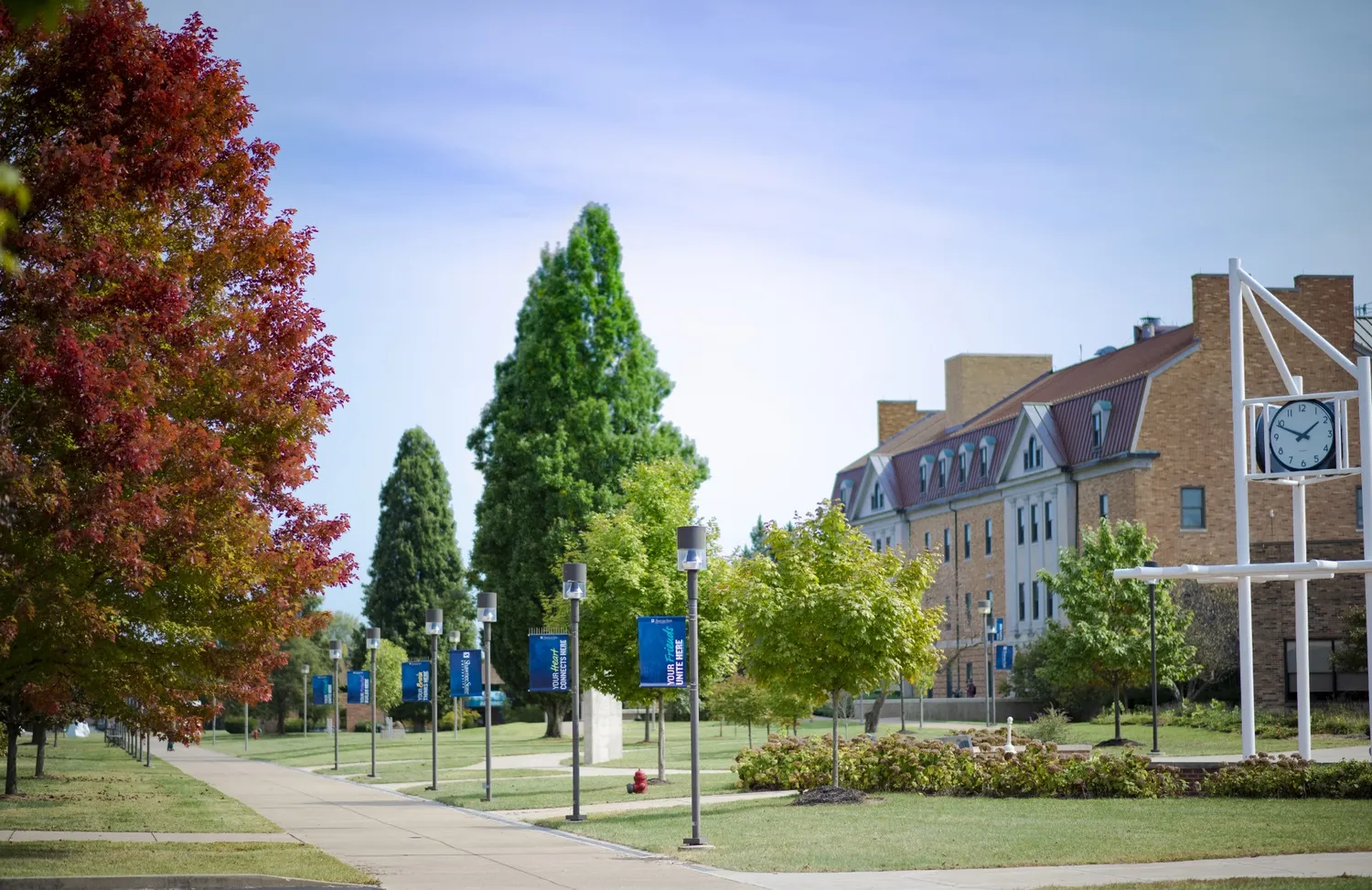
On campus at Shawnee State University in Portsmouth, Ohio.
Shawnee State University has a math club, where actuarial students participate in club meetings and activities, and a chapter of Pi Mu Epsilon, the national mathematics honor society.
- Actuary (life, health, property/casualty, pension)
- Risk analyst or underwriter
- Insurance, banking, or financial consultant
- Data analyst or quantitative analyst
- Graduate study in actuarial science, statistics, or financial mathematics
Graduates work in insurance, consulting, banking, and financial institutions, with a strong demand for credentialed actuaries across the country.
For more information about employment and career paths for actuaries, visit the Society of Actuaries, Be an Actuary or the Casualty Actuary Society.
“The program is designed perfectly to set you up to pass the preliminary exams and to knock out educational credits needed. It was especially helpful to have courses dedicated to working through study manuals for these preliminary exams. Working through this program, you not only get the base knowledge, but also exposure to how that knowledge is going to be tested.”
“I really appreciated that by the time you got into the upper level math courses, there would often be less than 10 students in the course. I think this has fringe benefits that folks don’t typically think of. In particular, the faculty get to know you and will take action to help you succeed. For instance, the faculty helped me get an actuarial internship. Additionally, I can remember a situation where two classes that I needed were not offered every semester and were being held at the same time. It was a scheduling issue that would have delayed my graduation by a semester. However, I went to each of the professors and they allowed me to schedule both classes and worked with me outside of class when needed to make sure I was keeping up.”
“Shawnee State University is in a great location for an aspiring actuary as it is just two hours from Cincinnati and Columbus, both of which are big insurance hubs. Many schools offer actuarial science degrees, which can be limiting, but SSU’s degree is a concentration of the mathematical science degree which can keep more doors open to students. The two courses in the requirement that target problem solving are crucial extensions of the theoretical classes that one would take in a math only degree. These courses are critical for preparing for actuarial exams and are cost effective and efficient. Finally, the course requirement to get exposure to programming is a necessity for the actuary of tomorrow, where the ability to scale solutions is a must.”
Build confidence in everything from developmental math through advanced calculus.
Access assistance, structured study sessions, and peer coaching tailored to your coursework.Dayton duMeleau Math Success Center
Free Tuition and Financial Aid
Shawnee State's tuition is among the lowest in Ohio, and the Shawnee Advantage Tuition Guarantee keeps your rate flat for four years. Scholarships including Choose Ohio First and the Pell-Eligible Free Tuition Program may also apply.
See if you Qualify for Free Tuition
Ohio students can apply to receive a $1,500 scholarship up to full-tuition when you apply and are accepted.
Learn More about Choose Ohio FirstBachelor of Science in Mathematics: Actuarial Science Frequently Asked Questions
No. The B.S. in Mathematical Sciences is offered on campus only.
Internships aren't required, but they're strongly encouraged - especially in actuarial-adjacent roles like insurance, banking, or risk.
Graduates work in insurance, consulting, banking, financial institutions, and data analytics, among other fields.
Program handbook
Contact the Department of Mathematical Sciences for the current program handbook and advising materials.
Accreditation
Shawnee State University is accredited by the Higher Learning Commission (HLC) and recognized by the Society of Actuaries as one of the universities and colleges with an actuarial program with introductory curriculum.
Shawnee State University is an educational member of the Insurance Industry Resource Council of Ohio. As such, this program is partnered with an insurance company to enhance understanding of the insurance industry and promote opportunities for internships and permanent jobs in the insurance industry.
